
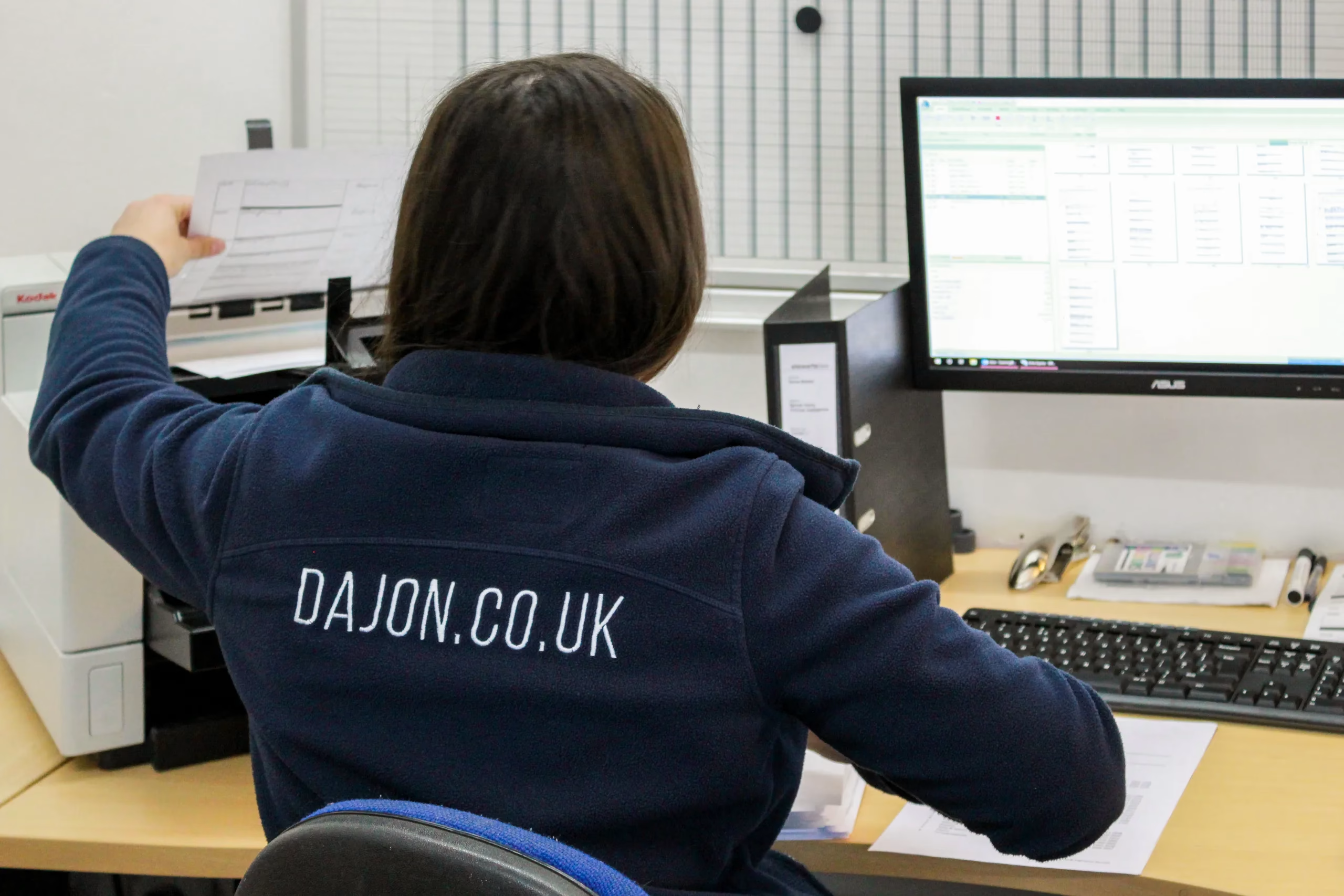
Dajon turns paper archives into indexed, searchable files and delivers them into SharePoint or your document management system, ready for search and AI. We digitise up to 50 boxes in 10 to 15 working days, to BS 10008 and ISO 27001, for insurers, law firms, NHS bodies and other regulated organisations. Prices start at £0.03 an image.
Digitisation at a glance
| Price | From £0.03 an image; £0.03 to £0.12 depending on preparation, indexing and output (pricing) |
| Turnaround | 10 to 15 working days for up to 50 boxes; larger archives in agreed phases |
| What we digitise | Office files, lever arch files, loose papers, forms, deeds, large format plans, books and bound records |
| What you receive | Text-searchable PDF/A files with an index of the fields you choose. |
| Where files go | SharePoint, your document management system or secure transfer. |
| Your originals | Returned, stored by Dajon or securely destroyed with a certificate |
| Collection | UK-wide, from our London office in Southwark and our facility in Orpington |
| Minimum order | £250 |
| Standards | BS 10008 since May 2014, ISO 27001 since October 2010, Cyber Essentials since October 2014, NHS DSPT 2025-26 (version 8) – Standards exceeded |
| Public sector | Supplier on RM6346 Lot 3 (NHS patient records) and Lot 4 (specialist records management) |
What your archive becomes
Scanning makes an image of each page. Digitisation makes those images useful: the text is made searchable, every document is indexed the way your teams look for it, and the files arrive in the system they already use. How findable your records become depends on the indexing level you choose.
| Indexing level | What we capture | Typical use |
|---|---|---|
| Box or batch (included) | Box number, date range, department | Archives you rarely search |
| File or folder | File name or reference, such as a client number or employee ID | HR, client and patient files |
| Document | Document type and date for each document in a file | Claims, contracts, deeds |
| Field-level data capture | Named fields such as policy number, amount or address, checked and exported as data | Feeding a system, invoice processing, AI projects |
Every project includes OCR on typed text, file naming to an agreed convention and quality checks on readability and page counts. Not sure which level you need? Tell us how your team searches for records today and we will recommend one.
Choose the right digitisation service
- Bulk scanning: The whole archive in one managed project, often for office moves, archive reduction or ending a storage contract.
- Scan on demand: Keep your boxes in our storage and digitise single files as you need them, from £15 a file.
- Historical and archival scanning: Careful handling and high-resolution capture for fragile and historic material, including photographs.
- Survey scanning: Paper surveys and questionnaires turned into data ready for reporting.
- Medical records scanning: Patient records digitised under the NHS Data Security and Protection Toolkit.
- Data capture: Named fields from each document, checked and delivered as data.
Still deciding? Our buyer’s guides compare bulk back-scanning with scan on demand and off-site storage with digitisation.
How it works
1. Scope and sample
We agree the records, index fields, output and deadline, then digitise a sample for your sign-off.
2. Secure collection
Boxes are barcoded and tracked from your site to ours, with a recorded chain of custody.
3. Preparation
We remove staples and bindings, repair damaged pages and keep every file in its original order.
4. Scanning
Pages are captured to BS 10008 on Kodak Alaris production scanners.
5. OCR, indexing and capture
Text is recognised, documents are split and named, and index fields are captured and verified.
6. Quality checks
Images and index data are checked before release.
7. Delivery
Files and metadata are loaded into SharePoint or your DMS, or sent by secure transfer.
8. Originals
Returned, stored in our secure facility with two-hour emergency retrieval, or destroyed with a certificate.
See every step in detail on our scanning process page.
Into SharePoint, your DMS or a new system
Most clients want digitised files where their teams already work. We map your index fields to SharePoint columns or DMS metadata, follow your folder and naming rules, and keep access in line with your records policy. If you are leaving shared drives or an old system at the same time, our data migration service moves existing digital files alongside the newly digitised ones.
Ready for AI, not only for search
An AI tool can only use what it can read. Records are ready for AI when the text is accurate, every document carries consistent metadata and the files sit in a governed location your tools are allowed to reach. We build those three things into the digitisation, so the archive does not need fixing a second time. For AI-led projects, see AI data readiness, including governance aligned with ISO 42001, the EU AI Act and ICO guidance. Data is processed in the UK.
Legally admissible records
BS 10008 is the British Standard for the evidential weight and legal admissibility of electronic information, and Dajon has been certified to it since May 2014. Working to it means each digital file can be shown to be a true and complete copy of the original. Our guide to legal admissibility explains when paper originals can be destroyed.
Security and compliance
Your records stay under Dajon’s control from collection to delivery. We hold ISO 27001, BS 10008, Cyber Essentials and the NHS Data Security and Protection Toolkit, and work as your data processor under UK GDPR Article 28 terms. Certificate numbers, sub-processors, data location and continuity arrangements are in our trust centre.
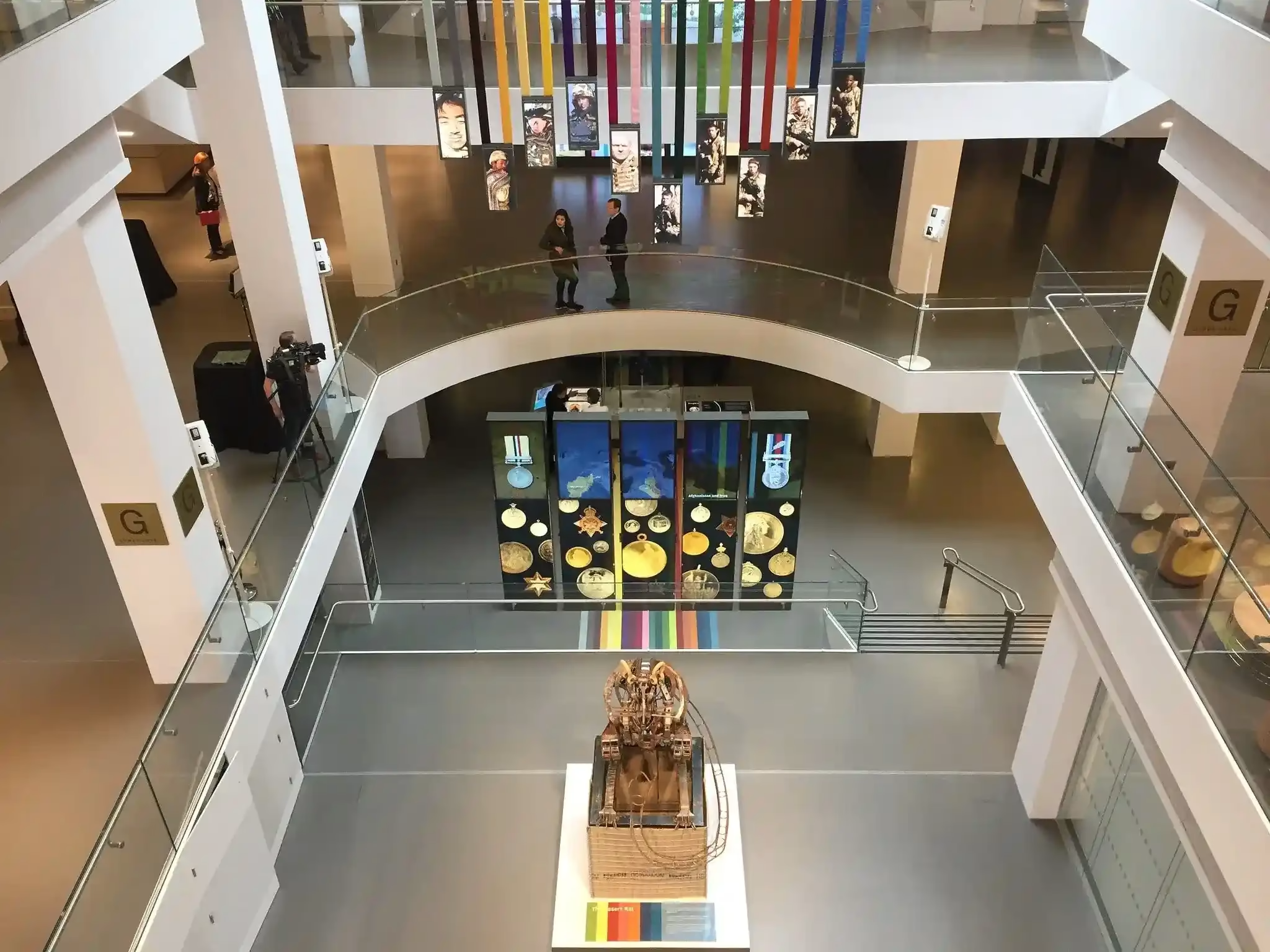
Proven Document Scanning Project
National Army Museum
Approximately 70,000 historical photographs digitised
Dajon digitised approximately 700 folders containing around 70,000 photographic prints for the National Army Museum, including historical photographs dating back to the late 1870s.
The project required careful document handling, audit trails and specialist scanning of historic material.
What digitisation costs
Digitisation starts at £0.03 an image and rises to £0.12 as the work on each page grows. Six things set the price:
- Volume: Larger archives cost less per image.
- Condition and preparation: Stapled, bound, fragile or mixed-size papers take longer to prepare.
- Indexing depth: A box-level index costs less than file- or document-level indexing.
- Data capture: Each extra field captured and verified adds to the price.
- Turnaround: Faster deadlines need more scanning capacity.
- Your originals: Storage term, return or secure destruction.
Our pricing guide and page-count calculator give an estimate, and we confirm the quote after seeing a sample.
Frequently Asked Questions
What is document digitisation?
Document digitisation turns paper records into digital files that people can search, share and manage in a system. It includes scanning, but also text recognition (OCR), indexing, quality checks and loading the files where they will be used.
What is the difference between document scanning and digitisation?
Scanning creates an image of each page. Digitisation is the whole job around it, from preparing the papers to indexing each document and loading it into your systems. See document scanning for the capture detail.
Should we digitise our whole archive or only what we need?
Digitise everything when you want to clear space, end a storage contract or search the whole archive at once. If you only open a few files a year, keep the boxes in storage and use scan on demand, from £15 a file.
How much does document digitisation cost?
Standard business scanning typically costs £0.03 to £0.12 per image, depending on volume, preparation and the output you need, with a £250 minimum order. Deeper indexing and data capture add to the price, and we quote from a sample of your records.
How long does it take to digitise an archive?
A project of up to 50 boxes of standard office paper typically takes 10 to 15 working days from collection to final delivery. Larger projects run to an agreed schedule, and files you need urgently can be digitised first.
Which indexing level do we need?
It depends on how your team searches. A box-level index is included and suits archives you rarely open; file, document or field-level indexing suits records you search by client, claim or date.
What format will our files be in?
Searchable PDF as standard, with PDF/A, TIFF and JPEG available, plus an index file in CSV or XML that maps every document to its metadata.
Can we destroy the paper originals after digitisation?
Often, once the digital copies are checked and your retention rules allow it. We only destroy originals with your written approval, to BS EN 15713, and issue a certificate of destruction.
Can you digitise photographs, plans and bound books?
Yes. We digitise photographs, bound volumes and drawings, maps and plans up to A0, handling fragile items one at a time on flatbed or large-format scanners.
Is our data kept in the UK?
Yes. All digitisation takes place at our own UK facility, we do not use sub-processors or transfer data outside the UK, and digital images are encrypted in transit and at rest.
Tell us about your archive
Send us the approximate number of boxes or pages, the type of records and your deadline, and we will reply within one working day.