
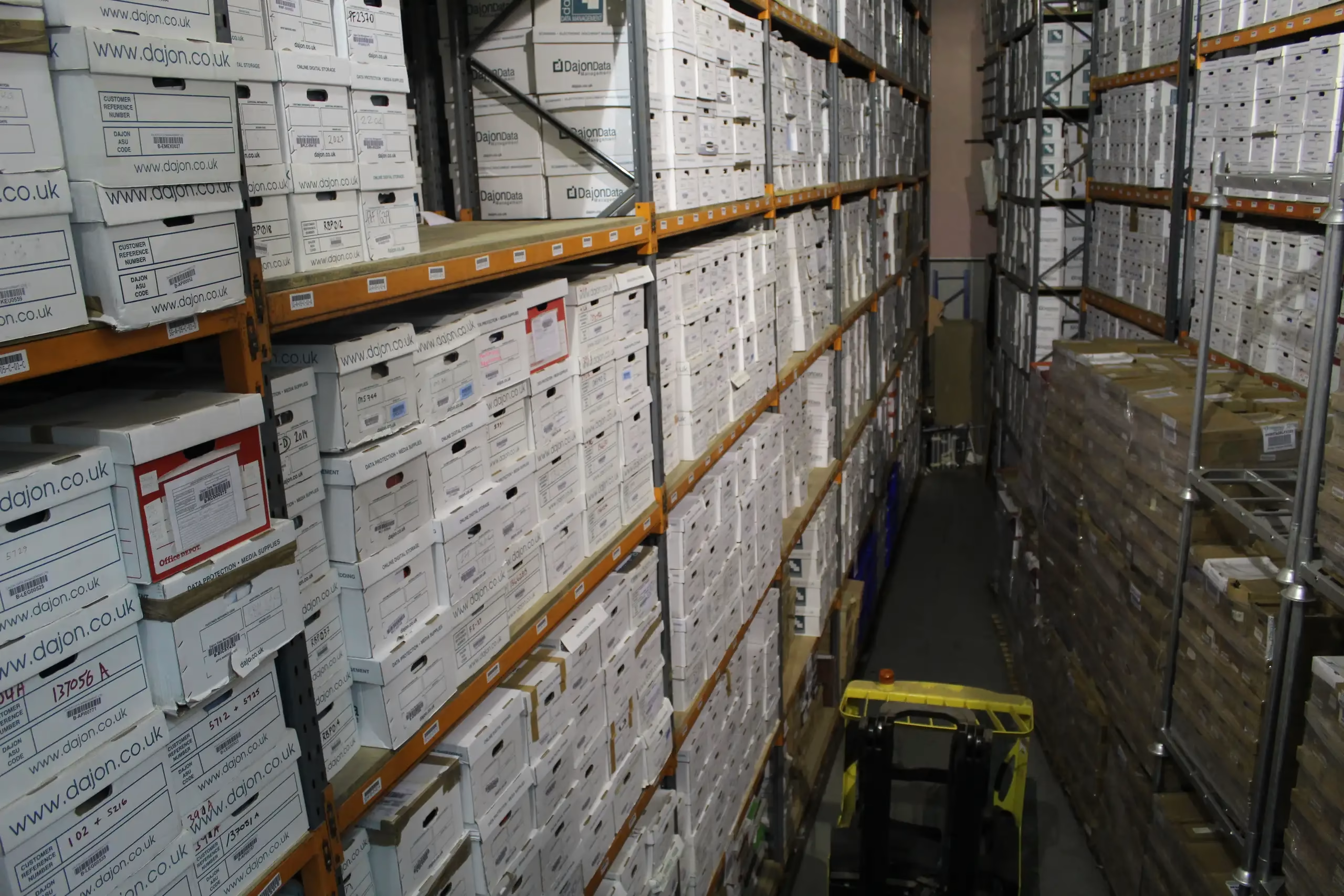

If retrieval and permanent withdrawal charges are making your document storage contract expensive, several UK providers now publish terms that remove or reduce those costs. Dajon Data Management charges no permanent withdrawal fees and no minimum invoice. Storetec offers free permanent withdrawal and secure destruction for new clients’ boxes. Secure Data Management’s Essential service for up to 100 boxes has no exit fees and a published monthly price, and Iron Mountain publishes bundle prices for small businesses. Before you switch, check your current contract’s notice period and exit charges, and look at whether you can cut how many boxes you store and how often you retrieve them. That often saves as much as a cheaper rate.
This article is written by Dajon, one of the providers listed. We have only included what each company publishes on its own website, listed providers alphabetically and linked to every source. Details were checked in November 2026, and pricing changes, so confirm current terms with each provider in writing.
Where storage costs actually come from
The monthly rate per box is the figure most people compare, but it is rarely what makes a storage contract expensive. The costs that grow are the ones charged each time you use your archive, and the ones charged when you want to leave it.
| Charge | What it covers | Why it matters |
|---|---|---|
| Storage rate | Monthly or annual fee per box or per cubic foot | Predictable, but grows with every box you add |
| Minimum invoice | A floor on each bill, whatever you store or use | Penalises small archives |
| Intake | Collecting, barcoding and indexing new boxes | A one-off cost, often repeated when switching |
| Retrieval and refile | Finding a box or file and putting it back | Charged on every request, so frequent users pay the most |
| Delivery and collection | Transport each way, often with surcharges for urgent or same-day service | Urgent requests usually carry a premium |
| Scan on demand | Scanning a file and sending a digital copy | Can be cheaper than a physical retrieval and return |
| Permanent withdrawal | A per-box fee when a box leaves storage for good | Charged when you switch provider, digitise or take records back |
| Destruction | Secure shredding at the end of retention | Can apply even when you are reducing your archive |
| Price increases | Annual rises, sometimes linked to inflation indices | Compounds over long contracts |
Permanent withdrawal fees deserve particular attention because they apply per box, at exactly the point you want to change something. Moving a large archive to a new provider, digitising it or destroying records you no longer need to keep can all trigger them. Multiply your provider’s per-box withdrawal fee by your total box count to see what leaving would cost today.
UK providers publishing more flexible pricing terms
Iron Mountain
Iron Mountain publishes small business storage bundles for 75, 150, 250 and 350 boxes, priced from £19.15 per week, with a dedicated account manager and pre-payment discounts. Retrieval and refile, and 24/7 access, are optional add-ons charged separately[1]. This suits organisations that want a predictable storage bill and expect to retrieve files rarely.
Secure Data Management
Secure Data Management’s Essential service is a self-managed option for up to 100 boxes, with tiered monthly prices published on its website and no exit fees. There is a three-month minimum storage period and 30 days’ notice to cancel after that. Deliveries and collections are charged at a published flat fee plus a per-box charge, and the first collection is free. The service uses storage sites in London and Swindon[2]. For larger archives, the company offers a savings analysis and says switching from Iron Mountain will be cost neutral[3].
Dajon Data Management
Dajon charges no permanent withdrawal fees and no minimum invoice, so boxes can be scanned, returned or destroyed without an exit penalty, and small archives aren’t penalised. Its file-saver system compresses hole-punched documents and can reduce the number of boxes stored by up to 50%[4]. Dajon’s records centre is in Orpington, in the London Borough of Bromley, and it publishes next-day delivery for requests made before 3pm, two-hour emergency delivery and scan on demand as an alternative to physical retrieval[5].
Storetec
Storetec offers free permanent withdrawal (“perm out”) and secure destruction for all new clients’ boxes stored with it. Its archive storage facilities are in Hull, and it publishes scan-on-demand turnaround within four working hours and box retrieval within 24 hours[6].
Cut costs before you switch
A cheaper contract helps, but the biggest savings usually come from storing less and retrieving less. These steps work with any provider, including the one you have now.
- Destroy what you no longer need to keep: Apply a retention schedule and securely destroy records past their retention date. The ICO notes that keeping more personal data than you need is inefficient and can bring unnecessary storage and security costs[7]. Check whether your current provider charges for destruction or treats it as a permanent withdrawal.
- Replace physical retrievals with scan on demand: If staff only need to read a document, a scanned copy avoids retrieval, delivery, refile and return charges on the box.
- Digitise the files people use most: In many archives, a small number of files account for most requests, and your retrieval history will show whether yours is one. Scanning those files once stops them generating retrieval charges.
- Store fewer, fuller boxes: Consolidating half-empty boxes, or compressing files, reduces the number of boxes you pay for each month.
- Renegotiate with your data: Use your provider’s invoices to calculate your real annual cost, including every retrieval and delivery, and take that figure into any renegotiation or tender.
Check your current contract before you move
Switching provider is often the right answer, but the cost of leaving is set by the contract you already have. Before you request quotes, check:
- Term and renewal: When the current term ends, whether it renews automatically and how much notice you must give.
- Exit charges: Per-box permanent withdrawal fees, any charges for collection by another provider, and whether destruction carries a separate fee.
- Your inventory: Whether you can export a full list of your boxes and files, with the descriptions and references your staff use to find them.
- Price increase clauses: How and when your rates can rise during the term.
Some providers offer to help with the cost or logistics of switching, so ask each one how they handle collection from your current supplier and how they rebuild your inventory when the boxes arrive.
How Dajon helps
Dajon charges no permanent withdrawal fees and no minimum invoice, so you can scan, return or destroy boxes later without a penalty. File-saver compression can cut the number of boxes you pay to store by up to 50%, and scan on demand replaces many physical retrievals. When you switch from another provider, Dajon plans the move with you and barcodes every box on arrival. Its storage cost calculator shows what your current archive costs.
Frequently asked questions
What is a permanent withdrawal fee?
A permanent withdrawal fee, sometimes called a perm-out fee, is a charge for removing a box from storage for good rather than retrieving it temporarily. It is usually charged per box, so it can become a significant cost when you switch provider, digitise your archive or take records back in-house.
Which UK document storage providers don’t charge permanent withdrawal fees?
Dajon Data Management states that it charges no permanent withdrawal fees. Storetec offers free permanent withdrawal and secure destruction for new clients’ boxes, and Secure Data Management’s Essential service for up to 100 boxes has no exit fees. Check the current terms with each provider before signing.
Is it worth switching document storage provider to save money?
It depends on your current contract’s exit charges, your box count and how often you retrieve files. Compare the total annual cost under each option, including retrieval, delivery and scanning, and add any one-off exit and intake costs. For archives with frequent retrievals or plans to digitise, lower usage and exit charges often outweigh a small difference in the monthly rate.
How can I reduce retrieval charges without changing provider?
Use scan on demand instead of physical delivery where staff only need to read a document, digitise the files that are requested most often and keep your index accurate so files are found first time. Destroying records past their retention date also reduces the number of boxes you pay to store.
What should I ask a new provider before moving my archive?
Ask for every charge in writing: Storage, minimum invoice, intake, retrieval, refile, delivery, urgent delivery, scan on demand, destruction and permanent withdrawal. Ask how they will collect from your current provider, how long the move will take and how they will check that every box arrives and is indexed.
If retrieval and withdrawal charges are driving up your storage costs, talk to Dajon about your box count and how often you use your archive. You can also read our shortlist of London records management providers for storage and urgent retrieval.
References
- Small business solutions Iron Mountain[↩]
- Essential Archive Storage Secure Data Management[↩]
- Storing with Iron Mountain? Secure Data Management[↩]
- Secure Document Storage Solutions Dajon[↩]
- Document Storage Services in London Dajon[↩]
- Archive Storage Solutions Storetec[↩]
- Principle (e): Storage limitation ICO[↩]