
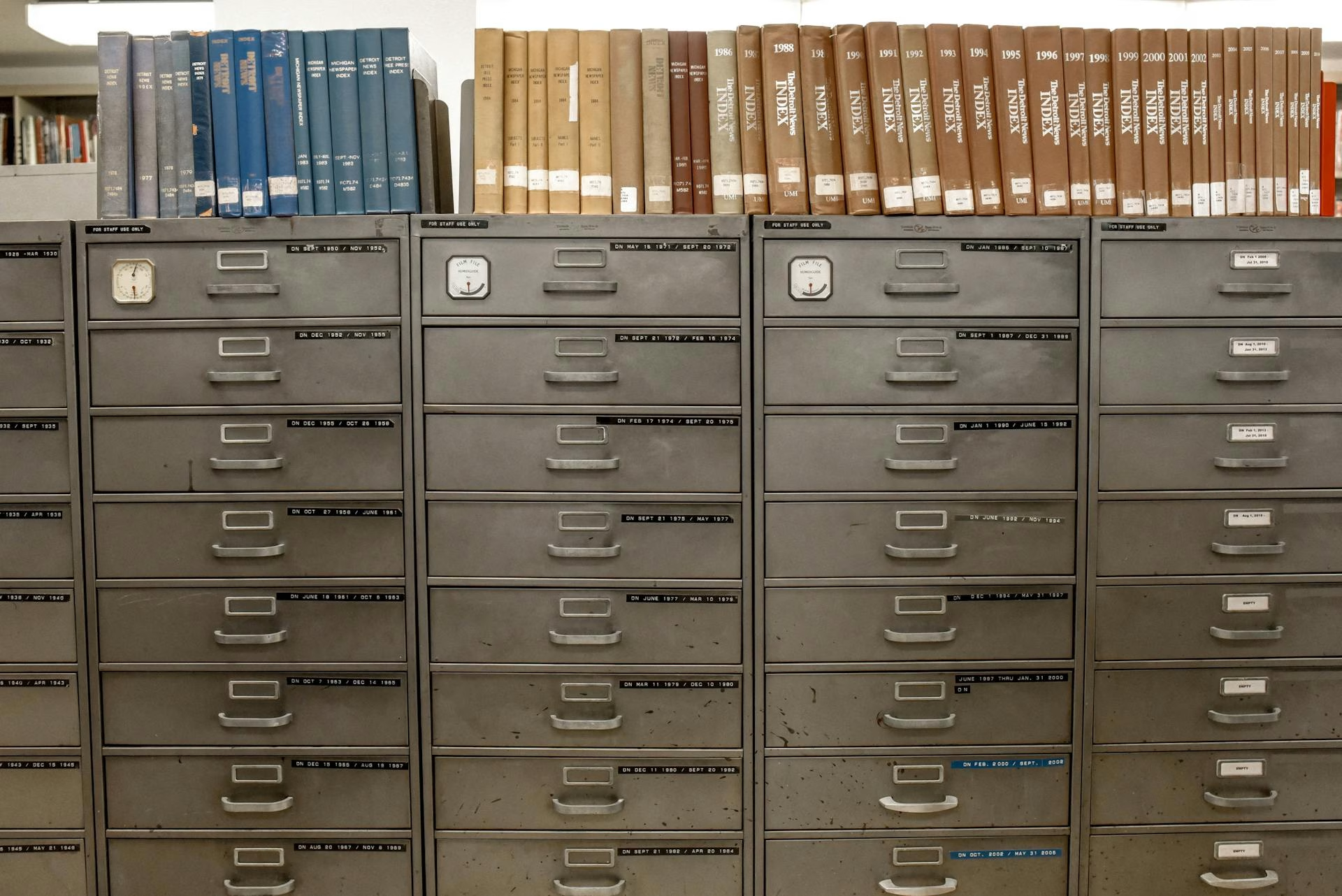
The filing cabinet is not just inconvenient. It is a compliance risk.
Across financial services, legal, insurance, and healthcare, critical records still sit in paper form – contracts, client correspondence, regulatory filings, HR documentation, policy files. These documents are often required to demonstrate compliance, respond to audit requests, or support legal proceedings. And yet they remain locked in storage rooms, offsite archives, or filing systems that rely on someone remembering which box they are in.
The case for digitisation is obvious. Searchable digital records can be retrieved in seconds rather than days. They can be backed up, access-controlled, and audited. But for regulated organisations, the process of getting from paper to digital is where the risk lies.
Simply scanning documents does not make them compliant. Without the right controls, it can make things worse.
Where paper records create risk
Paper is fragile in ways that matter to regulators. Documents can be misfiled, damaged by water or fire, or lost during office moves. Retrieval during an audit or regulatory investigation depends on physical access, manual searching, and – often – institutional memory about where specific files were stored.
In a sector like financial services, where the FCA expects firms to produce records promptly on request, a slow or incomplete response to a regulatory query is not just embarrassing – it can trigger further scrutiny. In legal services, failing to locate a critical document during disclosure can have direct consequences for a case.
The challenge compounds with scale. UK regulated organisations generate between 40,000 and 120,000 documents per year on average[1]. Organisations holding tens or hundreds of thousands of paper records across multiple locations face a growing governance problem: The more records they hold, the harder it becomes to demonstrate that every document is stored correctly, retained for the right period, and accessible when needed.
Why scanning alone is not the answer
This is where many digitisation projects go wrong. The assumption is that converting paper to PDF solves the problem. In practice, it often just moves the problem from a physical filing cabinet to a digital one.
A folder full of unsearchable image files with inconsistent naming conventions is no easier to navigate than a shelf of unlabelled boxes. If documents are not indexed with structured metadata – document type, date, client reference, retention period – they remain effectively invisible to anyone who does not already know they exist.
For regulated organisations, the requirements go further. Records that may be needed as evidence must meet standards for legal admissibility. In the UK, BS 10008 sets out the requirements for ensuring that electronically stored information carries evidential weight[2]. Compliance with this standard means demonstrating that digital records are trustworthy, that their integrity has been maintained since capture, and that a complete audit trail exists.
Digitisation without these controls is not just inefficient – it can actively undermine an organisation’s compliance position by creating records of uncertain provenance.
What compliant digitisation actually involves
A digitisation programme that meets regulatory expectations needs to address four things.
Capture quality. Documents must be scanned at a resolution that faithfully reproduces the original. For most business records, 300 dpi full-colour duplex scanning is the baseline. The scanning process must include automated checks for multi-feeds and mis-feeds to ensure no pages are missed or duplicated.
Structured indexing. Every scanned document needs metadata: Document type, date, reference numbers, client or matter identifiers, and retention category. This metadata is what makes records searchable and auditable. Without it, digital archives quickly become as opaque as the paper originals. Effective data capture at the point of scanning is what transforms a static image into a governed record.
Access controls and audit trails. Sensitive documents must be accessible only to authorised personnel, with every access logged. Retention policies must be applied consistently, with automated alerts for documents approaching their disposal date. A robust electronic document management system provides the framework for this ongoing governance.
Legal admissibility. For organisations that may need to rely on scanned records in legal proceedings, compliance with BS 10008 provides the framework for demonstrating evidential weight. This includes cryptographic sealing at the point of archiving, qualified timestamps, and tamper-proof access logs[3].
When these elements work together, the result is not just a digital copy of a paper archive – it is a governed information environment that is faster, more reliable, and more defensible than the paper it replaces.
The operational dividend
Beyond compliance, well-executed digitisation delivers measurable operational benefits.
Employees stop losing hours to manual document retrieval. Audit requests that previously took days to fulfil can be completed in minutes. Physical storage costs – premises, security, environmental controls, retrieval services – can be reduced or eliminated.
For organisations handling large volumes of regulated documentation, the productivity gains are substantial. When a team can search an entire client file in seconds rather than requesting a box from an offsite archive and waiting two days, the effect on service quality and responsiveness is immediate.
How Dajon delivers compliant digitisation
Dajon Data Management works with regulated organisations to digitise physical records while maintaining the governance and security standards that compliance demands.
Dajon’s approach covers the full chain: Secure collection and handling of physical records, high-quality scanning to BS 10008 standards, intelligent indexing with structured metadata, and delivery into the client’s document management system or secure digital archive.
The result is a digital records environment that is searchable, auditable, and compliant – built to withstand regulatory scrutiny rather than create new exposure.
For organisations still relying on paper for business-critical records, the risk of inaction is growing. Regulators expect faster access to information. Clients expect faster service. And the operational cost of maintaining paper archives only increases with time.
The question is not whether to digitise. It is whether to do it properly.
References
- Document Management Systems for Regulatory Compliance: A Selection Guide CheckFile.ai[↩]
- Legality of Scanned Documents Dajon Data Management[↩]
- Digitisation Guidance The National Archives[↩]