
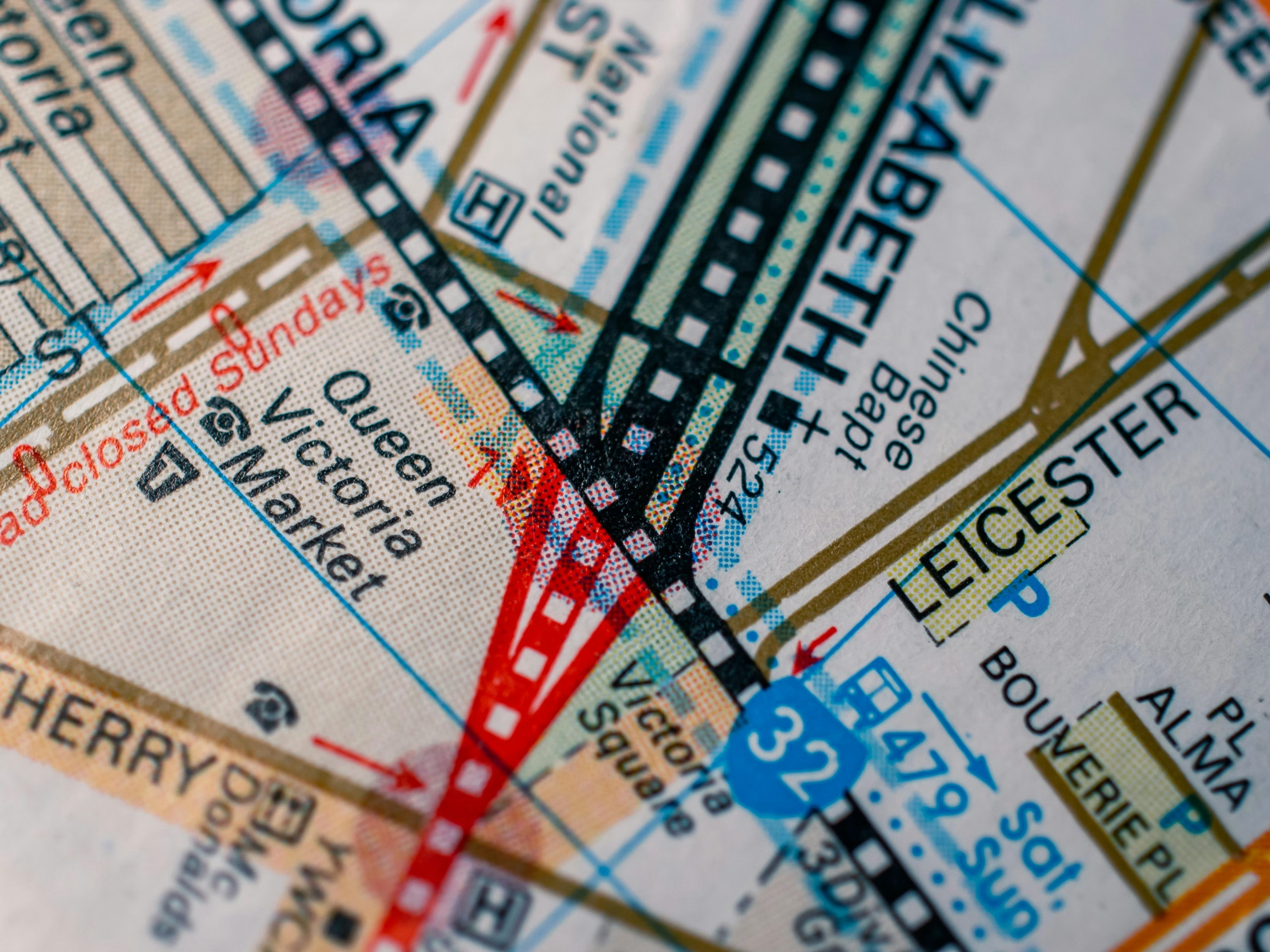

Think about the last time you used a paper road map.
Not a glance at a printed direction. An actual road map. Uunfolded on the passenger seat, orientated to the direction of travel, someone’s finger tracing a route across a page that was already out of date the moment it was printed.
You cannot remember. Because it has not happened for years. Possibly decades.
Nobody made a formal decision to stop using road maps. Nobody convened a committee to evaluate the alternatives and produce a recommendation. Nobody wrote a business case for the sat nav. The transition happened because the benefits were so obvious, the capability so clearly superior, and the cost of continuing with the old format so visible that the decision made itself.
Every road was still on the paper map. The data was not wrong. The format was just obsolete: incapable of updating, incapable of connecting to live information, incapable of answering a question in real time. Incapable, in the end, of being useful in the way that a modern navigation system is useful.
Your company archive is the road map. And the question that nobody has asked, in the same way that nobody asked it about road maps until the answer was already obvious, is why the data that runs the entire business is still in a format with exactly the same limitations.
What the road map got right. And why it still mattered
Before the sat nav existed, the road map was a genuinely sophisticated tool. It contained everything you needed to navigate from one place to another. Every road. Every junction. Every town. The data was organised, consistent, and reliable. For the environment it was designed for, it was entirely adequate – a world where navigation happened before the journey, not during it.
The archive is the same. Before the expectation that data should be instantly accessible, searchable across millions of records simultaneously, connectable to analytical systems, and available to AI tools that can extract patterns no human analyst could find manually; the physical archive was entirely adequate. It contained everything the business had ever recorded. The policies, the claims, the coverage decisions, the customer communications, the underwriting judgments. All of it was there.
The data is not wrong. The format is obsolete.
And the format is obsolete in the specific ways that matter most for a business operating in 2025. It cannot be searched. It cannot be queried. It cannot update. It cannot connect to the systems that need to use it. It cannot tell you what is in it without a manual search that may take hours or days. It cannot be read by an AI system, an automated workflow, or any analytical tool that the organisation has invested in or is planning to invest in.
The road map contained the same information as the sat nav. It was just in a format that could not deliver that information in the way that a modern journey requires.
The sat nav did not make the road map wrong. It made it expensive.
Here is the specific financial dynamic that the road map analogy makes visible, and that the archive equivalent makes financially significant.
When the sat nav arrived, the road map did not immediately become worthless. It still contained accurate information. It could still be used to navigate, with effort, in the way it always had been. The transition to sat nav was not driven by the road map becoming wrong. It was driven by the sat nav being so clearly better that continuing to use the road map was no longer rational.
But there was a cost to continuing with the road map that was not present when there was no alternative. Before the sat nav, the inefficiencies of paper navigation — the time spent planning routes in advance, the inability to respond to changed conditions, the errors that came from misreading a map under pressure — were simply the cost of how navigation worked. There was no benchmark against which to measure the waste.
After the sat nav, those inefficiencies became visible as a cost. The time spent planning a route that the sat nav could calculate in seconds. The wrong turns that live traffic updates would have prevented. The decisions made without current information that the sat nav would have provided.
Your archive is at exactly this inflection point.
Before digital data management existed, the inefficiencies of physical archive storage were simply the cost of how records management worked. The slow retrieval. The inability to search across records. The information that existed but could not be accessed quickly enough to inform a decision. These were not costs that could be measured against an alternative, because no alternative existed.
Now an alternative exists. And the inefficiencies of the physical archive are no longer simply the cost of how things work. They are a measurable waste. The difference between what physical storage costs and what digital storage costs, between what manual retrieval requires and what instant search delivers, between what a physical archive can tell you and what a properly structured digital environment makes visible.
For every 10,000 boxes, the lifetime physical storage cost is £8,132,963. The digital storage cost for the same data is £26,823. That is the road map premium: the extra cost of continuing with the format that was adequate before the alternative existed, now that the alternative is available.
The map that the sat nav runs on
There is a dimension to this analogy that goes beyond cost, and it is the dimension that connects the archive question to the AI investment question in a way that should matter to every CFO in a regulated financial institution.
The sat nav does not navigate from instinct or general intelligence. It navigates from maps. Specifically, from digital maps — structured, consistent, continuously updated representations of the road network that the navigation system can read, query, and use to calculate routes in real time.
Before the roads were digitised, sat navs could not exist in any meaningful sense. The technology for real-time navigation was available (GPS, digital displays, route calculation algorithms) but it had nothing to navigate with. The capability was present. The data foundation it required was not.
This is the exact situation most regulated financial institutions are in with AI.
The AI technology is available. The capability to extract insight from large volumes of records, to identify patterns in claims data, to detect fraud across transaction streams, to analyse portfolio concentration, to predict loss development. All of it is real and it is working in the organisations that have deployed it properly.
But it requires a data foundation. Specifically, it requires structured, consistent, machine-readable records that the AI system can read, query, and learn from. Without that foundation, the AI has nothing to navigate with. The technology is sophisticated. The data it requires is in boxes. On paper.
The organisations investing in AI without digitising their archives are investing in sat nav technology for a road network that has not yet been digitised. The technology will not perform as designed; not because it is inadequate, but because the data foundation it requires does not yet exist in a form it can use.
The archive digitisation programme is not a separate initiative from the AI programme. It is the prerequisite for it. It is building the digital map that the sat nav runs on. And without it, the sat nav stays in the box.
The journey the road map cannot make
There is one more dimension to the road map analogy that is worth stating directly, because it captures something about the archive problem that the cost argument alone does not fully convey.
The road map was adequate for the journeys that existed when it was created. It was designed for a world where routes were relatively stable, traffic conditions were broadly predictable, and the information needed to navigate was knowable in advance.
The modern journey is a journey the road map cannot make. Not because it lacks the data. Because it lacks the capability to deliver that data in the way the journey requires. That requires real-time traffic information, live rerouting, integration with destination systems, and the ability to respond to conditions that did not exist when the journey began.
The modern business decision — the one that requires instant access to decades of policy and claims history, pattern analysis across millions of records, integration with AI systems, real-time regulatory compliance monitoring, and the ability to answer questions that nobody thought to ask when the records were created — is a decision the physical archive cannot support. Not because it lacks the data. Because it lacks the capability to deliver that data in the way the decision requires.
The sat nav does not just make navigation faster. It makes journeys possible that the road map could not support at all. The digital archive does not just make retrieval faster. It makes decisions possible that the physical archive could not support at all.
This is the case for archive digitisation stated at its fullest. Not just cost reduction. Not just operational efficiency. The ability to make decisions that the current format of the data makes impossible: about risk, about claims, about capital, about AI.
The transition that makes itself
Nobody mourns the road map. Nobody argues that the transition to digital navigation was unnecessary or that the paper map deserved to survive. The transition happened because the benefits were obvious, the technology was available, and the cost of continuing with the old format (once the alternative existed) was impossible to defend.
The archive transition is at the same point. The benefits are quantifiable. The technology is available. The cost of continuing is impossible to defend once it is assembled on a single page: £8,132,963 per 10,000 boxes versus £26,823 in digital storage, before retrieval costs, compliance overhead, and the AI capability that cannot be unlocked until the data is in a usable form.
The road map became obsolete not through a single dramatic moment but through the accumulation of journeys where the sat nav was so clearly better that going back became unthinkable.
The archive is approaching that same moment.
Nobody gets a road map out anymore. The question worth asking — for a CFO who can see the cost differential, the compliance risk, and the AI investment waiting for a data foundation — is why the data equivalent of one is still running the business.
Start with the numbers. Run the calculator for your own organisation at www.dajon.co.uk/storage-cost-calculator. Then call us. The transition from road map to sat nav took a generation. This one takes ninety days.